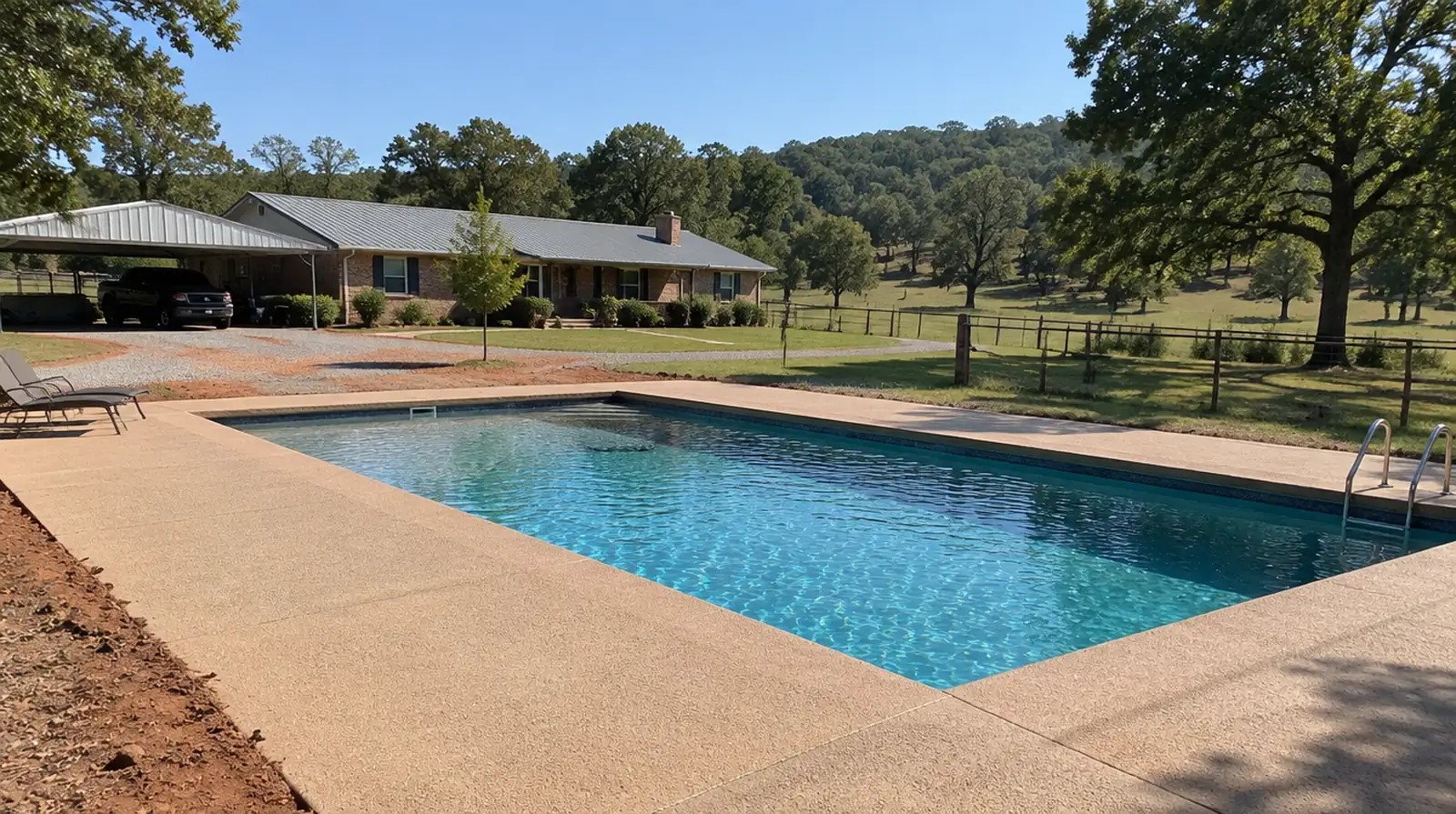
What we see on Sallisaw pool decks
Sallisaw sits where the Arkansas River valley meets the Cookson Hills, and the yards here show it. Some pools are in town on regular lots. Plenty more are out on a few acres, with woods on one side and pasture on the other. Either way, the concrete deals with the same eastern Oklahoma weather: long humid summers, heavy spring storms, and winters that bring a few hard freezes and the occasional ice storm.
The calls we get usually fall into a few groups:
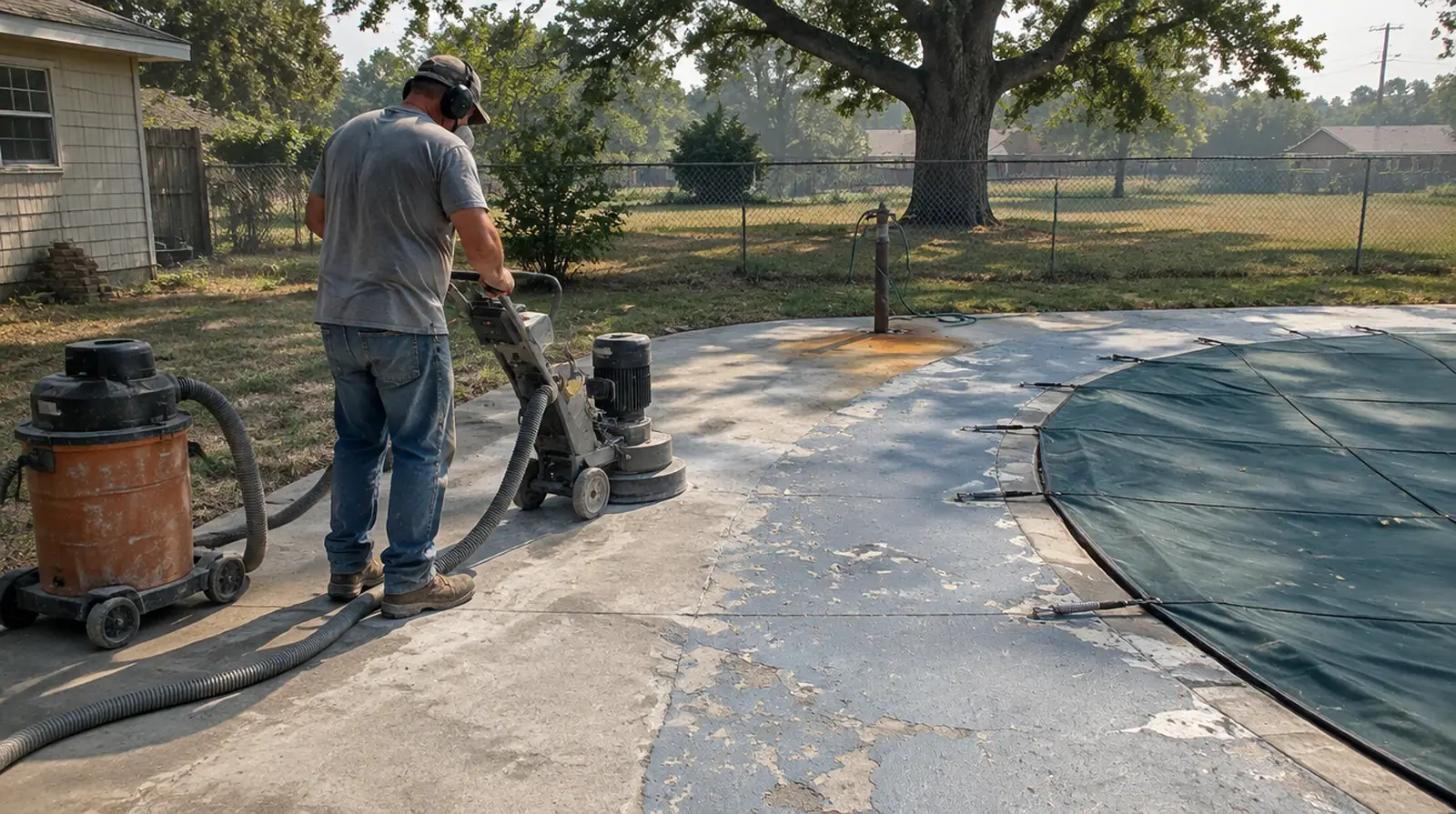
- Peeling paint. A lot of older decks were painted at some point. Paint looks good for a year or two, then blisters and flakes, and the bare spots get slick.
- Hot concrete. Bare broom-finish concrete in full sun is hard to stand on barefoot by mid-afternoon in July.
- Red dirt and rust stains. The soil around Sallisaw is a reddish loam and clay that rides in on shoes, tires and runoff. On homes with well water, the iron in it can leave orange stains wherever the hose or the auto-fill splashes.
- Cracks. Clay under a slab swells after a wet spring and shrinks in a dry August. Corners and the area around the steps crack first.
Prep that holds up
If there is paint on the deck, it has to come off. There is no coating that will stay stuck to paint that is already peeling. We grind it with a dust-collecting grinder down to clean concrete, and we keep the pool covered so the dust does not end up in your water.
Stains get treated before coating. Rust stains need a specific cleaner; a pressure washer alone will not lift them. Red-dirt staining usually comes out with grinding and washing. We want the concrete as even in color as we can get it, so nothing bleeds through a light finish later.
Cracks are opened up with a saw or grinder and filled with a flexible patch. Expansion joints stay open and get new sealant, so the slab still has room to move with the clay. Pitted spots from freeze-thaw get a skim coat to level them out.
The coating system
Once the deck is clean and dry, we roll on a primer that bonds into the concrete. Over that goes the texture coat. Most people here go with a knockdown texture, which gives good grip and hides the patches and old wear in a deck that has been around a while. The top is a UV-stable sealer with grit so it stays grippy when it is wet.
Color makes a real difference in summer. Sand, tan, light gray and soft white stay much cooler than dark colors and do not show red dust as quickly. We bring sample boards so you can set them out in the sun and feel the difference before you decide.
If your deck is in good shape and you mostly want to keep water and stains out of it, concrete sealing is a cheaper option that still helps. For the drive and carport slab that lead to the pool, see driveway coating.
Keeping it looking good
Hose off red dirt and leaves before they sit through a rain. Point the pool auto-fill and the yard hose so they do not spray the deck, especially on well water. Blow off oak leaves in the fall. A fresh coat of sealer every few years keeps the color bright and the texture protected.
Scheduling
We like to coat in April, May and early June, or again in September and October. The coatings need dry concrete and mild temperatures to cure, and spring storms can push dates around, so we plan a little cushion. Most decks take three to four days.
Questions
Do I need to drain the pool? No. We cover it and tape off the coping.
Can you coat around an above-ground pool? Yes, if there is a concrete pad or walkway around it.
Do you work outside town? Yes, across Sequoyah County, including Muldrow, Vian, Gore and Roland.
Make the pool deck safe again
Call (918) 208-0235. We will look at the old finish, the cracks and the stains, then give you a written price.